The Ohuhu Honolulu 320 is one of the best things to happen to budget-conscious artists in years. For a fraction of the price of a comparable Copic set, you get 320 dual-tip alcohol markers covering almost every hue, value, and saturation you'd ever need.
The challenge? 320 colors is genuinely a lot to navigate — especially if you're trying to find a specific shade, build a blending set, or figure out which Ohuhu marker is the closest match to a Copic or Prismacolor color you've seen in a tutorial.
This guide breaks it all down.
How the Honolulu 320 Is Organized
Unlike Copic's systematic alphanumeric codes, Ohuhu Honolulu markers use a simpler but less intuitive prefix + number system. The prefix tells you the color family:
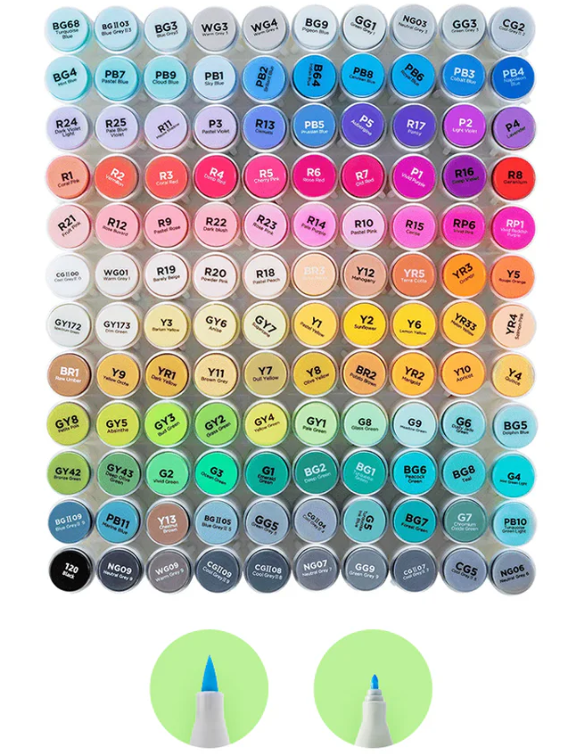
A complete set of Ohuhu Honolulu markers includes 320 colors
Within each family, numbers generally run light to dark — lower numbers are lighter, higher numbers are darker. So R1 is a pale blush pink, while R9 is a deep red.
The 320 vs. Smaller Sets: What's the Difference?
Ohuhu also sells smaller sets — 48, 80, 100, and 216 color versions. If you already own one of these and are considering upgrading to the 320, here's what you're gaining:
The jump from the 216 to the 320 adds primarily two things: more mid-tone shades within each color family (which means smoother gradients and better blending), and expanded coverage in earth tones and skin tone ranges. If you do portraits or detailed botanical work, those additions make a real difference.
If you're starting from scratch, the 320 is the obvious choice if it's in your budget — it gives you the blending range that alcohol markers need to shine.
The Most Useful Shades in the Set
With 320 options, decision fatigue is real. Here are the color families that deliver the most value in the Honolulu set:
Earth tones (E series): The E range in the Honolulu 320 is genuinely excellent — warm and cool browns, golden tans, and soft skin tones that blend beautifully for portraits, wood textures, and autumn palettes.
Grays (W, C, N series): Three full gray families means you have warm grays for cozy scenes, cool grays for modern palettes, and neutral grays that work anywhere. Having this range is what separates flat coloring from sophisticated shading.
Blue greens (BG series): The BG range covers everything from icy seafoam to deep teal — some of the most versatile and popular shades in the whole set for nature subjects and backgrounds.
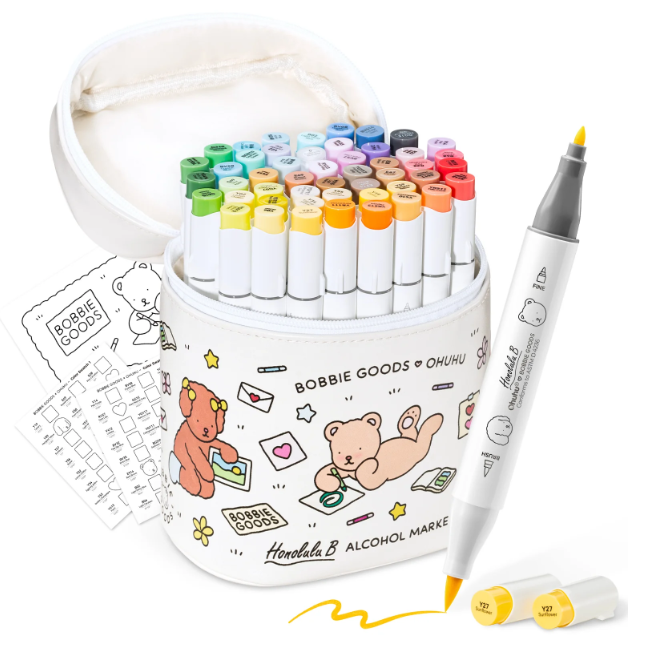
Ohuhu x Bobbie Goods Honolulu B 48 Colors Dual Tips Alcohol Art Markers, Brush & Fine
Ohuhu vs. Copic: What's Actually Different?
The honest answer is less than most people think, and more than Copic fans want to admit.
Both are dual-tip alcohol markers. Both blend wet-on-wet. Both work on marker paper and bleedproof surfaces. The differences come down to:
Ink consistency: Copic ink is slightly more consistent cap to cap, especially in lighter shades. Ohuhu can vary a little more between individual markers.
Refillability: Copic markers are refillable and have replaceable nibs. Ohuhu markers are not. For hobbyists who color occasionally, this rarely matters. For daily heavy users, it adds up.
Color range: Copic has 358 colors with a deeply logical system. Ohuhu has 320 colors that may be loosely organized but offer an excellent variety. For most projects, 320 colors is more than enough.
Price: A full Copic Sketch set costs roughly $700–$900+. The Ohuhu Honolulu 320 runs $100–$130 depending on sales. The delta in results does not match the delta in price.
Finding the Copic Equivalent for Any Ohuhu Shade
This is the question every Ohuhu user eventually asks: "My favorite tutorial uses Copic codes — which of my Ohuhu markers is the closest match?"
The answer used to require a lot of cross-referencing. Now it takes about 10 seconds.
Head to MyKindofColor, type in a hex code or upload your reference image, and select Ohuhu Honolulu 320 from the brand filter. The tool shows you the closest Ohuhu match for every color in your palette — with a match quality rating, so you know how close you're getting.
You can also flip it: if a tutorial calls for Copic BG49, you can enter that hex code and see which Ohuhu marker is the best dupe. Often it's an Excellent match — close enough that on paper, you genuinely can't tell the difference.
Building Your First Blending Sets
The most common mistake new Ohuhu users make is treating the set like a rainbow sampler — picking one from every color. For blending, you want depth within a family, not breadth across the spectrum.
A good starting approach: pick 3–5 color families you use most, and make sure you have at least a light, mid, and dark within each. Then fill in the others gradually.
For a versatile starter blending kit from the 320:
That's 19 markers working together across 5 subjects — a cohesive working palette from a 320-piece set.
Shop Ohuhu markers on Amazon →
---
The full Ohuhu Honolulu 320 range is included in MyKindofColor's database. Upload any photo or enter any hex code to find your closest Ohuhu match — and see how it compares to Copic, Altenew, and more.