If you've ever looked at a Copic color code like BV23 or YR68 and thought "I have no idea what that means" — you're not alone. At first glance, Copic's alphanumeric system looks random. But here's the thing: it's actually one of the most logical color coding systems in the art supply world once you understand the rules.
Learn it once, and you'll be able to decode any Copic color instantly — and find your closest match without ever opening a swatch book.
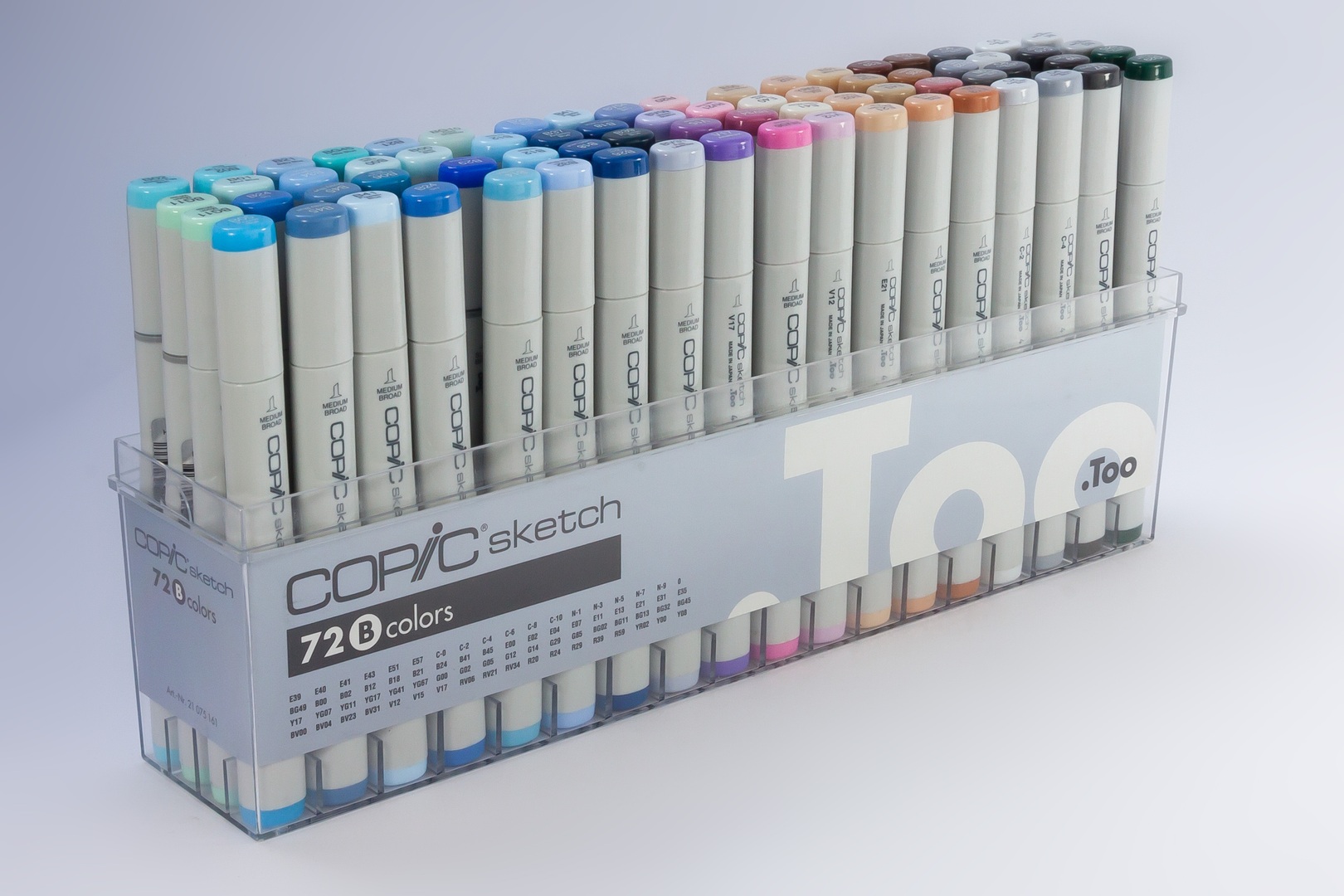
Copic Sketch markers are available in sets of 3, 6, 12, 24, 36 and 72 as well as the complete set of 358
The Four Parts of Every Copic Code
Every Copic color is described by a code made up of four components: a color family letter, an optional second letter, a saturation digit, and a brightness digit. Let's break each one down.
Part 1: The Color Family Letter(s)
The letters at the start of the code tell you the color family. Copic groups all 358 colors into these families:
So BV23 is a Blue Violet. YR68 is a Yellow Red (orange). E47 is an Earth tone. Already making more sense?
Part 2: The First Digit — Saturation
The first number after the letters tells you how saturated (vivid or muted) the color is. This is where Copic gets a little counterintuitive:
So B00 is a brilliant, vivid blue. B99 is a nearly gray, very muted blue. The lower the first number, the punchier the color.
Part 3: The Second Digit — Brightness
The second number tells you how light or dark the color is:
So B01 is a light, vivid blue. B09 is a dark, vivid blue. B91 is a light, muted blue. B99 is dark and muted — basically a blue-gray.
Putting It All Together: A Real Example
Take BV23:
Result: a medium-brightness, fairly vivid blue-violet. Exactly what you'd expect if you pulled the cap off a BV23 marker.
Now take E47:
Result: a dark, medium-warm brown — which is exactly what Dark Brown looks like.
The One Exception: 0-Series Blenders
Copic also makes colorless blenders — 0, B000, BV000, etc. — that have a 0 in the saturation spot. These are used for softening edges, lifting color, and blending transitions. They follow the same family logic but contain no pigment.
How to Use the System Practically
Once you understand the structure, the Copic system becomes your best shopping tool. Want a lighter version of BV23? Try BV21 or BV20. Want a more muted version? Try BV34. Building a gradient? Go BV20 → BV23 → BV25 → BV29 for a seamless light-to-dark progression in the same family.
This is how Copic artists build sets so deliberately — they're not randomly collecting colors, they're choosing specific positions across the saturation/brightness grid to guarantee smooth blending.
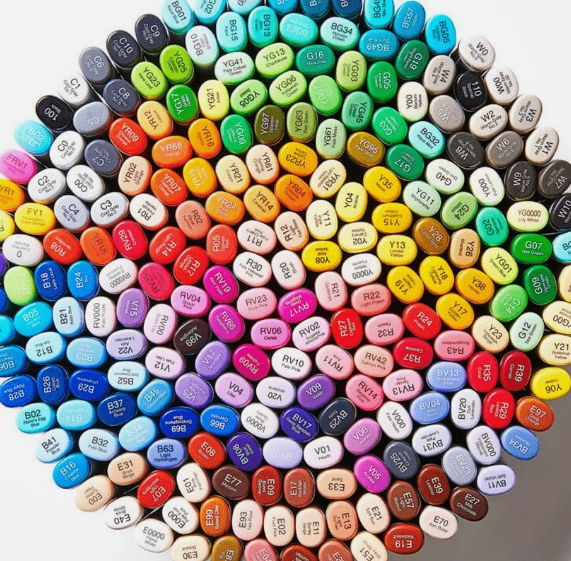
A complete set of Copics includes 358 colors
Finding Your Copic Equivalent
Already own Prismacolor pencils or Ohuhu markers and want to know which Copic color matches? Or following a tutorial that calls for a Copic you don't own and want to know if something in your stash is close?
Upload the reference to MyKindofColor, or type in the hex code of the Copic color, and the tool will show you the closest match across every supported brand — ranked by accuracy using Delta E 2000 color science.
No more cross-referencing three different PDFs or hoping the Youtuber mentions an equivalent.
The Quick-Reference Cheat Sheet
Here's the Copic system at a glance. Screenshot this:
That's the whole system. Once it clicks, shopping for Copics — and following tutorials that use them — gets dramatically easier.
---
MyKindofColor includes the full Copic Sketch range. Type any Copic code into the hex matcher or upload a reference image to find equivalents across Ohuhu, Prismacolor, Faber-Castell, and more.